
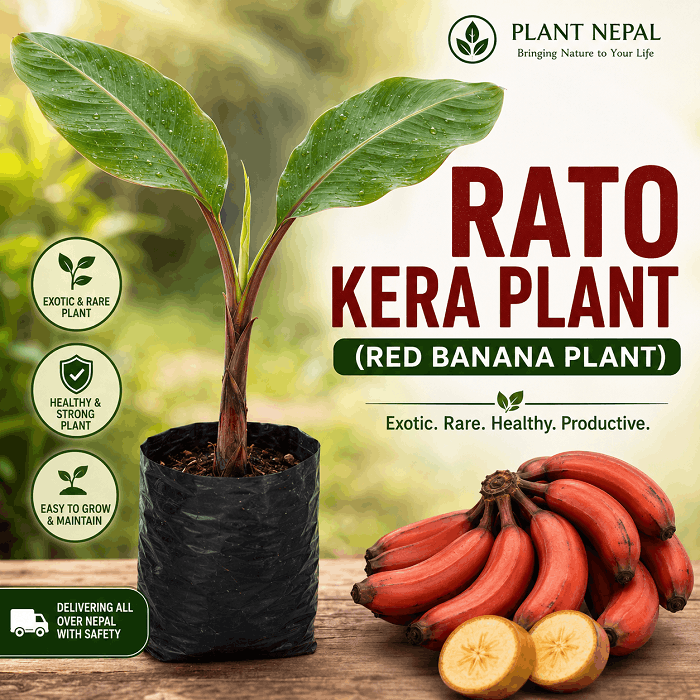
Description
Rato Kera Plant: 7 Amazing Reasons to Grow Red Banana
Rato Kera Plant, also known as Red Banana Plant, is a beautiful choice for plant lovers, home gardeners, collectors, and anyone who wants to bring a tropical and exotic character into their garden. With its lush foliage, attractive appearance, and fascinating banana-growing habit, this plant can turn an ordinary garden, terrace, backyard, farm, or large container space into something much more special.
At Plant Nepal, we believe that choosing a plant is more than simply buying greenery. It is about bringing home a living companion that can grow with you for years. That is why we focus on providing exotic, rare, special, and carefully selected plants for gardening enthusiasts across Nepal.
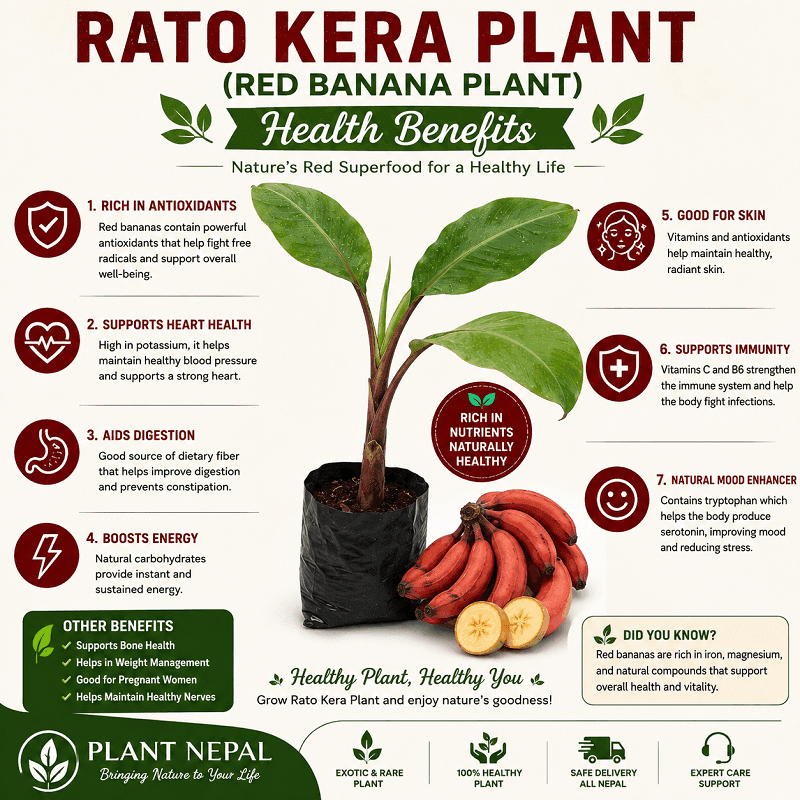
At Plant Nepal, we focus on providing exotic, rare, and special plants for plant lovers across Nepal.
If you are searching for a Rato Kera Plant in Nepal, this guide will help you understand its appearance, growing requirements, planting method, watering, sunlight, soil, feeding, container growing, seasonal care, and the important things to consider before purchasing.
🌱 Plant Nepal Promise: We aim to provide quality exotic and special plants with responsible packing, safe delivery, and practical consultation support for our customers.
What Is a Rato Kera Plant?
The Rato Kera Plant is a type of banana plant valued for its attractive appearance and distinctive red or reddish coloration associated with certain red banana cultivars. Unlike ordinary banana plants that are commonly grown mainly for fruit production, red banana plants can also be highly attractive as ornamental garden plants.
Bananas belong to the Musa group and are herbaceous perennial plants rather than true woody trees. Their apparent “trunk” is actually a pseudostem formed by tightly packed leaf bases. Banana plants are known for their large, paddle-shaped leaves and vigorous growth under suitable warm conditions.
For Nepalese gardeners, the Rato Kera Plant can be an exciting addition because it offers both ornamental appeal and the satisfaction of growing a tropical fruiting plant.
However, one important point is worth remembering:
Not every banana sold under a common name is necessarily the same cultivar.
Different banana cultivars can vary considerably in fruit colour, plant height, growth habit, cold tolerance, fruiting time, flavour, and ornamental characteristics. Therefore, responsible sourcing and proper identification are important when purchasing an exotic banana plant.
That is exactly where a specialist nursery such as Plant Nepal can make the buying experience easier for gardeners.
Why Plant Nepal?
Buying an exotic plant is different from buying an ordinary household product.
A living plant needs appropriate handling, careful packaging, transportation, and after-delivery care. A plant can also experience temporary stress when moved from a nursery environment to a customer’s garden.
At Plant Nepal, our goal is to make that process safer and more convenient for plant lovers.
We specialize in:
- 🌱 Exotic plants
- 🌿 Rare plants
- 🍌 Special fruit plants
- 🌴 Tropical and ornamental plants
- 🪴 Garden and container plants
- 🌳 Selected plants for home gardens
- 📦 Safe plant delivery across Nepal
- 💬 Plant-care consultation for customers
Our customers are not just looking for “a plant.” Many are looking for something unusual, beautiful, productive, or difficult to find locally.
The Rato Kera Plant fits perfectly into that category.
7 Amazing Reasons to Grow Rato Kera Plant
1. Rato Kera Plant Brings an Exotic Tropical Look
One of the biggest reasons gardeners choose a Rato Kera Plant is its visual appeal.
Banana plants have naturally dramatic foliage. Their large leaves immediately create a tropical atmosphere, making them excellent focal plants for gardens, courtyards, terraces, farm landscapes, and other outdoor spaces.
If you enjoy creating a garden that looks different from the usual collection of roses, marigolds, ornamental shrubs, and common fruit plants, a banana plant can provide a completely different character.
A healthy Rato Kera Plant can become a beautiful feature near:
- Home entrances
- Garden corners
- Backyard spaces
- Farm boundaries
- Tropical-style gardens
- Large terraces
- Courtyards
- Resorts and homestays
- Restaurants and cafés
- Landscaping projects
- Fruit gardens
The broad leaves create an instant tropical feeling.
For gardening hobbyists, this is particularly attractive because the plant itself becomes part of the garden design—not simply a future source of fruit.
2. It Is Perfect for Plant Lovers Who Want Something Different
Plant collectors rarely want only common plants.
Once a gardener becomes interested in plants, curiosity naturally grows:
“What unusual plant can I grow next?”
That is where a Rato Kera Plant becomes interesting.
Instead of choosing another common ornamental plant, you can experiment with a banana cultivar that has a distinctive appearance and tropical character.
For plant hobbyists, growing an exotic plant is also an experience.
You get to observe:
- New leaf development
- Changes in leaf colour
- Plant height
- Sucker formation
- Growth speed
- Flower development
- Fruit development
- Seasonal changes
- Response to fertilizer
- Response to sunlight and watering
Every new leaf can feel like a small achievement.
That makes the Rato Kera Plant more than just a landscaping plant—it can become part of your gardening journey.
3. Rato Kera Plant Can Become a Garden Focal Point
A good garden needs visual balance.
Some plants work as background greenery. Others work as borders. Some provide flowers, while others provide fragrance.
Large-leaved banana plants can work particularly well as focal plants.
Place a healthy Rato Kera Plant where it can naturally attract attention without overcrowding the surrounding plants.
For example, you could combine it with:
- Ginger
- Turmeric
- Lemongrass
- Hibiscus
- Ornamental grasses
- Ferns
- Flowering tropical plants
- Ground-cover plants
This can create a layered garden design.
A taller banana plant provides vertical interest, while smaller plants fill the lower level.
If you have a garden that feels visually flat, adding a large-leaved tropical plant can dramatically improve its appearance.
4. It Can Be an Exciting Fruit-Growing Project
For many gardeners, the biggest attraction of a banana plant is the possibility of growing bananas at home.
Growing fruit yourself creates a completely different connection with gardening.
Instead of purchasing fruit from a market, you get to experience the process from plant establishment to flowering and fruit development.
However, gardeners should understand that fruiting depends on several factors, including:
- Cultivar
- Plant maturity
- Temperature
- Sunlight
- Soil quality
- Water availability
- Nutrition
- Growing season
- Plant health
- Local climate
- Proper care
Therefore, buying a Rato Kera Plant should not be considered a guarantee of immediate fruit production.
A young plant needs time to establish itself.
With proper care and suitable environmental conditions, mature banana plants can eventually produce flowers and fruit. Banana cultivation guidance from the Royal Horticultural Society notes that established banana plants require a long, warm growing season for fruit production, with good sunlight and suitable temperatures playing important roles.
This is one reason why gardening patience matters.
5. Rato Kera Plant Can Grow in Different Garden Settings
One advantage of banana plants is their flexibility in garden design.
Depending on the plant size and available space, a Rato Kera Plant can be grown in the ground or, when appropriately sized, maintained in a sufficiently large container.
Growing in the Ground
Ground planting is generally the better choice when you have enough outdoor space and suitable soil.
Choose an area with:
- Good sunlight
- Protection from strong winds
- Fertile soil
- Good drainage
- Consistent moisture
- Enough room for mature growth
Bananas generally prefer rich, consistently moist but well-drained growing conditions and a warm, sheltered location.
Growing in a Container
Container growing can be useful for gardeners who have:
- Terraces
- Courtyards
- Large balconies
- Rooftops
- Small gardens
- Rental properties
However, a banana plant is not a miniature plant forever.
As the plant grows, its root system and above-ground structure require more space. A container-grown banana therefore needs an appropriately large pot and regular attention to watering, nutrition, drainage, and repotting.
If you are planning container cultivation, ask the Plant Nepal team about the plant size and suitable container requirements before planting.
How to Grow Rato Kera Plant Successfully
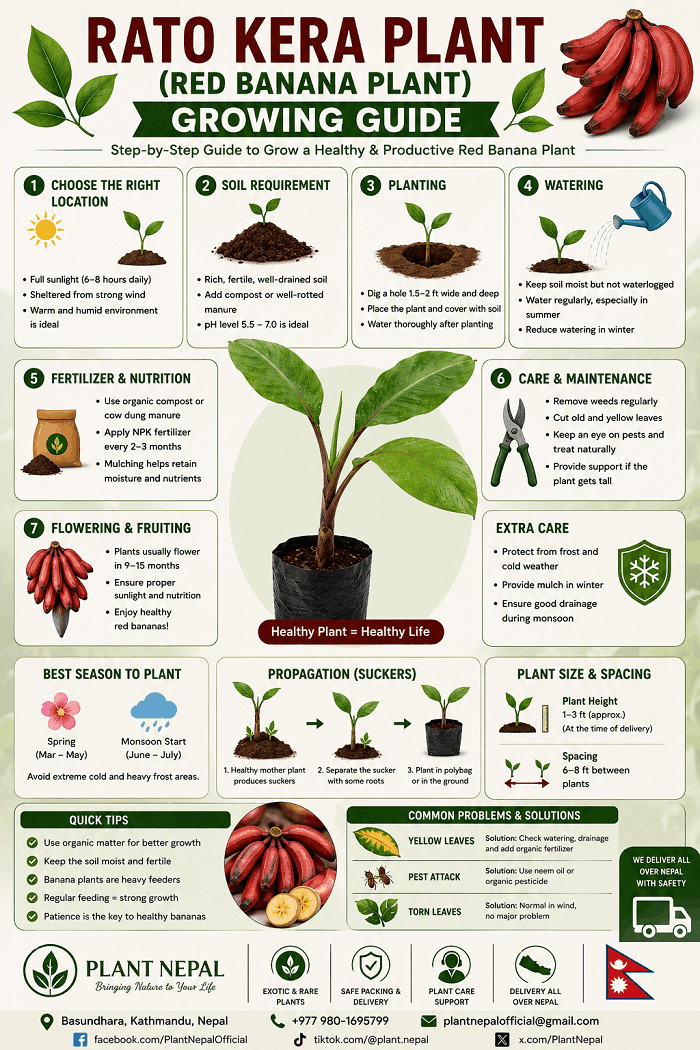
Buying a healthy plant is only the first step.
The next step is giving it an environment where it can establish strong roots and produce healthy foliage.
Sunlight Requirements
The Rato Kera Plant generally performs best in a bright location with plenty of sunlight.
Choose an area where the plant can receive strong natural light for much of the day.
Good sunlight supports:
- Stronger growth
- Healthy leaves
- Better overall plant structure
- Photosynthesis
- Potential flowering and fruiting
However, recently delivered or newly transplanted plants may experience temporary stress.
If your plant has travelled a long distance, avoid immediately exposing a stressed plant to extreme environmental conditions.
Allow it to acclimatize gradually.
Soil Requirements
Good soil is fundamental to banana cultivation.
A suitable growing medium should hold enough moisture while still allowing excess water to drain away.
The ideal approach is to avoid two extremes:
Too dry → root stress
Too wet → poor root health and possible rot
Organic matter can help improve soil structure and moisture retention.
Before planting your Rato Kera Plant, loosen the soil and incorporate well-decomposed organic matter where appropriate.
Avoid planting directly into compacted soil.
If water remains around the root zone after rainfall or irrigation, improve drainage before planting.
Watering Rato Kera Plant
Banana plants generally appreciate regular moisture, particularly during active growth.
But regular watering does not mean keeping the roots permanently waterlogged.
A simple principle for gardeners is:
Moist soil + good drainage = healthier growth.
During hot and dry weather, the plant may require more frequent watering.
During prolonged rainfall, irrigation should be adjusted according to soil moisture.
Container plants may dry out faster than plants growing in the ground, so check them regularly.
The RHS also recommends increased watering during active growth, particularly for plants growing in containers or fast-draining soil.
Fertilizer and Feeding
Fast-growing banana plants can be hungry plants.
Once established, regular feeding can support vigorous foliage and overall development.
A balanced fertilizer or suitable organic nutrient program can be used according to the plant’s growth stage and soil condition.
For gardeners interested in fruit production, nutrition becomes even more important.
Do not assume that more fertilizer automatically means better growth.
Over-fertilization can damage plants.
Instead:
- Understand your soil.
- Use appropriate fertilizer.
- Follow the recommended application rate.
- Water appropriately.
- Observe plant response.
- Adjust feeding according to growth.
For detailed general banana cultivation guidance, you can also consult the RHS Banana Growing Guide.
Rato Kera Plant Care After Delivery
Plant delivery is a special stage because the plant has travelled from the nursery to your home.
Some temporary changes after transportation can be normal.
You may notice:
- Slight leaf bending
- Minor leaf damage
- Temporary drooping
- Reduced freshness
- Leaf-edge drying
- Transportation-related stress
Do not panic immediately.
Plants are living organisms, and transportation can temporarily disturb them.
What should you do after receiving your plant?
Step 1: Carefully open the package.
Step 2: Place the plant in a bright but suitable location.
Step 3: Check the moisture level of the growing medium.
Step 4: Avoid unnecessary root disturbance.
Step 5: Give the plant time to adjust.
Step 6: Gradually establish its normal sunlight and watering routine.
Step 7: Monitor new growth.
New leaves are often a much better indicator of recovery than older leaves.
Protecting Rato Kera Plant From Cold
Temperature is especially important when growing tropical and subtropical plants.
Banana plants vary considerably in their cold tolerance, so gardeners should not assume that every banana cultivar behaves the same way.
Cold weather can slow growth and damage foliage.
If your location experiences colder winter conditions, consider:
- Planting in a sheltered location
- Using mulch around the root zone
- Protecting young plants
- Moving container plants to a more protected location
- Avoiding cold wind exposure
- Monitoring winter temperature
General banana-growing guidance recommends protecting susceptible banana plants from frost and cold conditions.
For additional winter-care information, see the RHS Banana Winter Protection Guide.
Rato Kera Plant for Nepalese Gardens
Nepal has remarkable climatic diversity.
The growing conditions in Kathmandu Valley are different from those in the Terai, mid-hills, higher elevations, or cooler mountain regions.
Therefore, when purchasing a Rato Kera Plant, your location matters.
Before planting, consider:
Kathmandu Valley
Provide:
- Good sunlight
- Wind protection
- Well-drained soil
- Regular watering
- Winter protection for sensitive plants
Terai and warmer regions
Warm conditions can be highly suitable for banana cultivation, but irrigation and drainage become particularly important during hot or rainy periods.
Mid-Hill regions
Many gardeners can successfully grow banana plants with the right microclimate, especially in warmer, sheltered locations.
Cooler or higher elevations
Cold temperatures can become a limiting factor.
In such areas, container cultivation or protected locations may be worth considering depending on the specific cultivar.
Because banana cultivars differ, Plant Nepal recommends sharing your location with our team before purchasing if you are unsure about suitability.
Why Buy Rato Kera Plant From Plant Nepal?
Choosing a nursery is an important part of buying exotic plants.
A low-quality plant can create unnecessary frustration for a gardener.
At Plant Nepal, our goal is to make exotic plant ownership easier.
We focus on:
🌱 Carefully Selected Plants
We aim to offer interesting and special plants for Nepalese plant lovers rather than simply filling a catalogue with ordinary varieties.
📦 Safe Packaging
Living plants require careful handling during transportation. We take packaging and delivery safety seriously.
🚚 Nepal-Wide Delivery
We deliver plants to locations across Nepal, with appropriate care taken during packing and dispatch.
💬 Customer Consultation
Not sure where to plant your Rato Kera Plant?
Need help with watering?
Wondering whether your location is suitable?
Our team can provide practical guidance based on your situation.
❤️ Plant-Lover Focused Service
Plant Nepal is built for people who genuinely enjoy plants.
Whether you are an experienced collector or a beginner buying your first exotic plant, we want your experience to be simple, informative, and satisfying.
Who Should Buy a Rato Kera Plant?
The Rato Kera Plant can be an excellent choice for:
- 🌱 Home gardeners
- 🪴 Container gardening enthusiasts
- 🌿 Exotic plant collectors
- 🍌 Fruit-growing hobbyists
- 🌴 Tropical garden lovers
- 🏡 Home landscaping projects
- 🌾 Small farms
- 🏨 Resorts and homestays
- ☕ Cafés and restaurants
- 🌳 Garden designers
- 🎁 Plant lovers looking for something special
If you love unusual plants, the visual character of a banana plant can make a wonderful addition to your collection.
Rato Kera Plant: Advanced Growing Guide for Nepal
Growing a Rato Kera Plant successfully is not only about planting it in the soil and watering it occasionally. Like any living plant, it responds to its environment.
The more closely you understand its needs, the better you can support healthy growth.
For hobby gardeners, this is also what makes growing an exotic plant so enjoyable. You begin to notice small changes—new leaves, stronger stems, changing colour, new suckers, and eventually the possibility of flowering and fruiting.
Best Place to Plant Rato Kera Plant
Location is one of the first decisions you should make after receiving your Rato Kera Plant.
Choose a place that receives plenty of natural light and has good air circulation.
An ideal garden location should have:
- Good sunlight
- Fertile soil
- Reliable moisture
- Good drainage
- Protection from strong wind
- Enough space for future growth
- Easy access for watering and feeding
Avoid planting directly beside a wall, narrow pathway, or other plant where the large leaves will constantly be restricted.
Remember that a young Rato Kera Plant may look small when you purchase it, but banana plants can become substantially larger as they mature.
Planning for future growth will save you from unnecessary transplantation later.
How to Plant Rato Kera Plant
Once you have selected the right location, planting should be done carefully.
Step 1: Prepare the Soil
Dig a sufficiently wide planting hole rather than creating a narrow deep hole.
Loosen the surrounding soil so that developing roots can establish more easily.
Mix suitable organic matter into poor soil where necessary.
Step 2: Remove the Plant Carefully
If your Rato Kera Plant arrives in a nursery bag, handle it gently.
Do not pull the plant aggressively by the leaves or pseudostem.
Instead, support the root ball and carefully remove the nursery container.
Step 3: Position the Plant
Place the root ball at approximately the same depth at which it was previously growing.
Avoid burying the pseudostem unnecessarily deep.
Step 4: Fill the Hole
Return the prepared soil around the root ball.
Press gently enough to remove large air pockets without compacting the soil excessively.
Step 5: Water Thoroughly
Water the newly planted Rato Kera Plant after planting.
This helps settle the soil around the roots.
Step 6: Monitor
For the first several days and weeks, observe:
- Leaf condition
- Soil moisture
- New growth
- Wilting
- Pest activity
- Drainage
Do not immediately apply excessive fertilizer simply because the plant looks stressed after transportation.
Rato Kera Plant Watering Schedule
There is no single watering schedule that works perfectly for every garden.
The right frequency depends on:
- Temperature
- Rainfall
- Soil type
- Container size
- Plant size
- Sun exposure
- Drainage
- Season
Instead of watering according to a fixed calendar, check the growing medium.
If the surface is drying quickly and the plant is actively growing, watering may need to be increased.
During heavy monsoon rainfall, additional irrigation may not be necessary.
For container-grown Rato Kera Plant, monitor moisture more frequently because containers can dry out faster than garden soil.
A simple rule for beginners:
Check first → water when needed → avoid permanent waterlogging.
Monsoon Care for Rato Kera Plant in Nepal
Nepal’s monsoon can bring significant rainfall.
For banana plants, rainfall can be beneficial, but excessive water around the roots can create problems.
During prolonged rainfall:
Check Drainage
Make sure water can move away from the root zone.
Avoid Additional Watering
If the soil is already saturated, do not continue routine irrigation.
Watch the Leaves
Persistent yellowing, weak growth, or declining plant health may indicate problems with the root environment, although several other factors can also cause similar symptoms.
Protect Against Strong Wind
Large banana leaves can catch wind easily.
In exposed locations, strong winds may tear leaves or damage plants.
A sheltered planting position can therefore be valuable.
Winter Care for Rato Kera Plant
Winter requires additional attention, especially in cooler parts of Nepal.
Banana plants generally prefer warm conditions, and cold weather can slow growth.
If you live in a cooler location, consider:
- Planting near a warm, sheltered wall
- Protecting the root zone with organic mulch
- Reducing unnecessary watering during cold periods
- Protecting young plants from severe cold
- Moving container-grown plants to a sheltered area
- Avoiding cold wind exposure
Do not judge the health of your Rato Kera Plant only by older leaves during winter.
Cold-related leaf damage does not necessarily mean the entire plant has died.
The underground growing point and roots can remain viable depending on the cultivar and severity of the cold.
Rato Kera Plant and Mulching
Mulching can be useful around established banana plants.
Organic mulch can help:
- Reduce moisture loss
- Moderate soil temperature
- Improve soil organic matter over time
- Reduce weed competition
- Protect the soil surface
Suitable materials may include:
- Dried leaves
- Compost
- Straw
- Well-decomposed organic material
However, avoid piling wet organic material directly against the pseudostem.
Leave a small gap around the base to maintain airflow and reduce unnecessary moisture accumulation.
Managing Banana Suckers
One fascinating characteristic of banana plants is their ability to produce new shoots or suckers around the mother plant.
A mature Rato Kera Plant may eventually produce additional growth from its base.
This can become useful if you want to maintain a banana clump.
However, allowing too many shoots to grow simultaneously can create excessive competition for:
- Water
- Nutrients
- Light
- Space
If your goal is stronger development of the main plant, selective sucker management can be helpful.
For gardeners interested in propagation, always identify the growth correctly before removing it.
If you are unsure, contact the Plant Nepal team for guidance rather than cutting healthy growth unnecessarily.
Can Rato Kera Plant Be Grown in a Pot?
Yes, banana plants can be grown in containers when the container and growing conditions are appropriate.
This can be particularly useful for:
- Terrace gardeners
- Rooftop gardens
- Courtyard gardens
- Small home gardens
- Plant collectors
- Gardeners who want mobility
But there is one important consideration:
A small nursery bag is not necessarily the plant’s permanent home.
As the Rato Kera Plant develops, it may eventually need a larger container.
Choose a pot with:
- Adequate volume
- Good drainage holes
- Strong construction
- Suitable growing medium
- Enough stability to support the mature plant
Avoid using an oversized container with poor drainage simply because it looks impressive.
The growing medium and watering practices matter just as much as container size.
Common Rato Kera Plant Problems
Even a healthy plant can occasionally develop problems.
Here are some common situations gardeners may encounter.
Yellow Leaves
One yellow leaf does not automatically mean that something is seriously wrong.
Older leaves naturally age and decline.
However, widespread yellowing may be associated with:
- Water stress
- Poor drainage
- Nutritional imbalance
- Root problems
- Environmental stress
Look at the whole plant rather than reacting to one leaf.
Brown Leaf Edges
Brown edges can occur due to environmental stress.
Possible factors include:
- Dry soil
- Low humidity
- Strong wind
- Excessive heat
- Transportation stress
- Salt or fertilizer accumulation
Check the growing conditions before changing several things at once.
Torn Leaves
Don’t panic if the large leaves of your Rato Kera Plant develop tears.
Banana leaves are naturally delicate compared with their size, and wind can tear them.
In outdoor gardens, some leaf damage is normal.
A new healthy leaf is often more important than maintaining every older leaf perfectly.
Slow Growth
Slow growth may occur when conditions are not ideal.
Possible causes include:
- Low temperature
- Insufficient sunlight
- Poor nutrition
- Root disturbance
- Water stress
- Recent transplantation
Give the plant time to establish before making dramatic changes.
How Long Does Rato Kera Plant Take to Fruit?
This is one of the most common questions from buyers.
There is no single guaranteed number of months for every Rato Kera Plant.
Fruiting depends on:
- Exact cultivar
- Plant maturity
- Climate
- Temperature
- Sunlight
- Nutrition
- Water
- Plant health
- Growing conditions
A nursery plant may still need considerable time before reaching reproductive maturity.
Therefore, responsible sellers should avoid promising an unrealistic fruiting timeline without knowing the exact plant, cultivar, age, and growing conditions.
At Plant Nepal, we encourage customers to focus first on establishing a healthy plant.
A strong plant is the foundation for future flowering and fruit development.
Can Rato Kera Plant Grow in Kathmandu?
Yes, banana plants can be grown in suitable locations around Kathmandu, but local conditions should always be considered.
Kathmandu has cooler winters than Nepal’s tropical and subtropical lowlands.
Therefore, gardeners should pay particular attention to:
- Winter temperature
- Sunlight
- Shelter
- Drainage
- Planting location
- Winter protection
A warm, sunny and sheltered microclimate can make a meaningful difference.
If you are in Kathmandu Valley and want to grow a Rato Kera Plant, Plant Nepal can help you choose a suitable location and provide basic care guidance.
Can Rato Kera Plant Grow in the Terai?
The warmer Terai region can offer favourable conditions for many banana-growing situations.
However, warm temperatures alone do not guarantee success.
Good drainage becomes particularly important during heavy rainfall.
During hot and dry periods, regular moisture may also be necessary.
Your exact location, soil, irrigation system, and cultivar should all be considered.
Rato Kera Plant Buying Guide
Before purchasing an exotic plant, ask a few simple questions.
1. Is the plant healthy?
Look for:
- Healthy foliage
- Active growth
- Strong structure
- Appropriate moisture
- No obvious severe pest infestation
2. What is the plant size?
Plant size can affect:
- Shipping
- Pot size
- Establishment
- Transplanting
- Expected growth stage
3. What growing conditions does it need?
Ask about:
- Sunlight
- Watering
- Soil
- Fertilizer
- Temperature
- Container requirements
4. Is it suitable for your location?
Kathmandu, Pokhara, Terai, mid-hills, and higher elevations can have significantly different conditions.
5. What support is available after purchase?
This is particularly important for exotic plants.
At Plant Nepal, customers can contact us for practical plant-care consultation.
Why Responsible Plant Buying Matters
The exotic plant market is growing because more gardeners want something different.
But customers should not choose a plant only because an attractive photograph appears online.
A responsible plant purchase should consider:
Plant identity + plant health + growing requirements + realistic expectations + after-sales support.
At Plant Nepal, we believe customers deserve useful information before and after purchasing a plant.
Our goal is not simply to sell more plants.
Our goal is to help more plants survive, grow, and become part of successful gardens across Nepal.
That is why our service includes consultation for customers who need guidance.
Safe Delivery Across Nepal
One of the biggest concerns when purchasing plants online is transportation.
A plant is not an ordinary parcel.
It is living material that must be packed with its condition and transportation journey in mind.
Plant Nepal works to provide safe plant delivery across Nepal, with appropriate packaging and handling.
Delivery conditions can vary depending on:
- Destination
- Distance
- Weather
- Road conditions
- Plant size
- Plant type
- Transportation method
Some minor changes to foliage may occur during transportation because plants are living organisms.
If your plant looks slightly different immediately after delivery, give it appropriate care and time to acclimatize.
If you have concerns, contact Plant Nepal with photographs of the plant and packaging so our team can guide you.
Frequently Asked Questions About Rato Kera Plant
Is Rato Kera Plant the same as Red Banana Plant?
Rato Kera Plant is commonly used in Nepal for red banana plants. However, common names can refer to different cultivars in different locations. For that reason, buyers should confirm the plant identity with the nursery.
Can I grow Rato Kera Plant at home?
Yes. With sufficient sunlight, suitable soil, adequate moisture, drainage, and enough space, it can be grown in a home garden. Container growing may also be possible with appropriate pot size.
Does Rato Kera Plant need full sunlight?
Banana plants generally perform well with plenty of sunlight. A bright, warm and sheltered location is usually preferable.
How often should I water Rato Kera Plant?
Watering depends on soil, weather, plant size and location. Keep the growing medium appropriately moist but avoid prolonged waterlogging.
Can I grow Rato Kera Plant in Kathmandu?
It can be possible in suitable Kathmandu locations. Because winters can be cooler, choose a sunny and sheltered location and provide appropriate cold protection.
Can I grow Rato Kera Plant in a pot?
Yes, provided the container is sufficiently large, stable and well-drained. As the plant grows, it may require a larger container.
Why are my banana leaves tearing?
Large banana leaves can tear naturally in wind. Some tearing is normal for outdoor plants and does not necessarily indicate serious disease.
Why is my Rato Kera Plant not growing quickly?
Cold temperatures, insufficient sunlight, transplant stress, poor nutrition, water problems or root disturbance can slow growth.
Can Plant Nepal deliver Rato Kera Plant outside Kathmandu?
Yes. Plant Nepal provides plant delivery across Nepal, subject to destination and transportation conditions.
Can Plant Nepal help me after purchasing the plant?
Yes. Plant Nepal provides consultation support to customers who need guidance regarding planting, watering, sunlight, location and general care.
A Plant Is a Long-Term Relationship
The best part of gardening is not always the harvest.
Sometimes it is the first new leaf.
Sometimes it is watching a tiny plant become a large garden feature.
Sometimes it is seeing your first flower.
And sometimes it is simply knowing that something green is growing because you took care of it.
A Rato Kera Plant can provide exactly that experience.
If you are a plant lover, hobby gardener, exotic plant collector, or someone beginning a new home garden, this unusual banana plant can become an exciting addition to your collection.
Choose the right location.
Give it suitable care.
Be patient.
And enjoy watching it grow.
🌱 Ready to Add Rato Kera Plant to Your Garden?
If you are looking for a Rato Kera Plant in Nepal, Plant Nepal is ready to help.
We specialize in exotic, rare and special plants, with safe delivery across Nepal and customer consultation support.
📍 Plant Nepal
Basundhara, Kathmandu, Nepal
📞 +977 980-1695799
📧 plantnepalofficial@gmail.com
📍 Visit Plant Nepal:
https://maps.app.goo.gl/Z2XSopEf1VeMGkMG6
Connect With Plant Nepal
Facebook:
https://www.facebook.com/PlantNepalOfficial/
TikTok:
https://www.tiktok.com/@plant.nepal
Plant Nepal — Bringing exotic, rare and special plants closer to plant lovers across Nepal.
Final Conclusion
The Rato Kera Plant is a beautiful choice for anyone who wants to grow something unusual, tropical and rewarding.
Its large foliage can transform a garden into a more exotic space, while the possibility of future flowering and fruiting makes it even more exciting for hobby gardeners.
Successful cultivation comes down to the basics: sunlight, fertile soil, appropriate moisture, drainage, nutrition, protection from unsuitable cold and consistent care.
Most importantly, remember that every plant needs time to establish.
Don’t judge your newly delivered plant too quickly.
Give it a suitable environment, observe its response, and enjoy the process.
At Plant Nepal, we want to make that journey easier by providing carefully selected exotic and special plants, safe delivery throughout Nepal, and practical consultation for our customers.
🌱 Find something rare. Grow something special. Make your garden yours with Plant Nepal.
Final Thoughts
A Rato Kera Plant is more than another plant for your garden.
It can become a tropical focal point, a gardening experiment, a fruit-growing project, and a beautiful part of your landscape.
The secret to success is not complicated:
Choose a healthy plant → provide suitable sunlight → use fertile, well-drained soil → maintain appropriate moisture → feed responsibly → protect from unsuitable cold → observe and care consistently.
And remember: every plant has its own personality.
One may grow quickly. Another may take longer to establish. A recently transported plant may need time to recover. Your job as a gardener is to create the right conditions and allow the plant to do what it naturally does best—grow.
If you are looking for a Rato Kera Plant in Nepal, Plant Nepal is here to help.
We provide exotic, rare, and special plants, safe delivery across Nepal, and consultation support for our customers.
🌱 Bring something exotic home. Grow something special. Grow with Plant Nepal.
🌱 Order Your Rato Kera Plant From Plant Nepal
📍 Location: Basundhara, Kathmandu, Nepal
📍 Map: Find Plant Nepal on Google Maps
📞 Phone: +977 980-1695799
📧 Email:
🌿 Plant Nepal
Responsible source for exotic, rare and special plants in Nepal.


Reviews
There are no reviews yet.